Payouts
Our API allows for convenient and secure payouts.
You can send payouts to any individuals to Visa and Mastercard cards.
Payouts made to cards cannot be refunded.
How to obtain card details for payouts
If necessary, you can collect bank card details for payouts on your side (you must comply with the additional PCI DSS requirements). Otherwise, you can use our widget: the recipient enters their card details in the widget and you will receive a token which you can then use to perform payouts to this card.
You can use our widget to get tokenized bank card data.
If you already have
- a hashed card number obtained via our widget
- a token for recurring payments
- a tokenized card number obtained via the
tokenize/elementsmethod
proceed with the payout using the token.
Card identifier
A card identifier is generated based on the card number and its expiration date if it is available. It allows determining which card the user is using and whether users' cards overlap (if multiple users are using the same card). Its value is passed in the card_id parameter.
By default, the card_id parameter is unique for each project but you can choose this value to be the same across all your projects.
A card identifier cannot be used to make payments or to retrieve all cards linked to a recipient.
How to make a payout
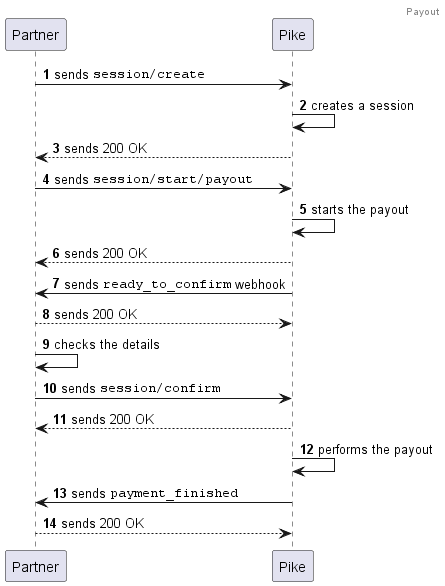
All API operations are carried out within a payment session.
To create a payout, complete the following steps:
-
Create a payment session sending a
session/createrequest.Alternatively, you can use the
session/init/payoutmethod. In this case, specify all the payout parameters right away and skip the next step. -
Send a
session/start/payoutrequest to start the payout. -
Wait for a
ready_to_confirmwebhook. When you receive it, it means that Pike is ready to make the payout and is waiting for your confirmation. -
Send a
session/confirmrequest or asession/cancelrequest to confirm or cancel the operation. -
Wait for a
payment_finishedwebhook containing the result of the payout. If the status issucceeded, the payout was successful. Learn more about the payout statuses.
Sequence diagram